Flood zone
Whether the home sits in a mapped flood zone, with the effective map date, plus tsunami zones near the coast.
FEMA, California Geological SurveyA reviewed PDF built from public records: flood, fire and ground hazards, water lines, nearby cleanup sites, power lines and airports. Every finding shows its source and date, and anything we couldn’t check is listed too.
Any California address · Checking is free · See a sample report

Each finding says what the record shows, what it does not tell you, who to ask next, and where it came from. Nothing is rolled into a mystery score.
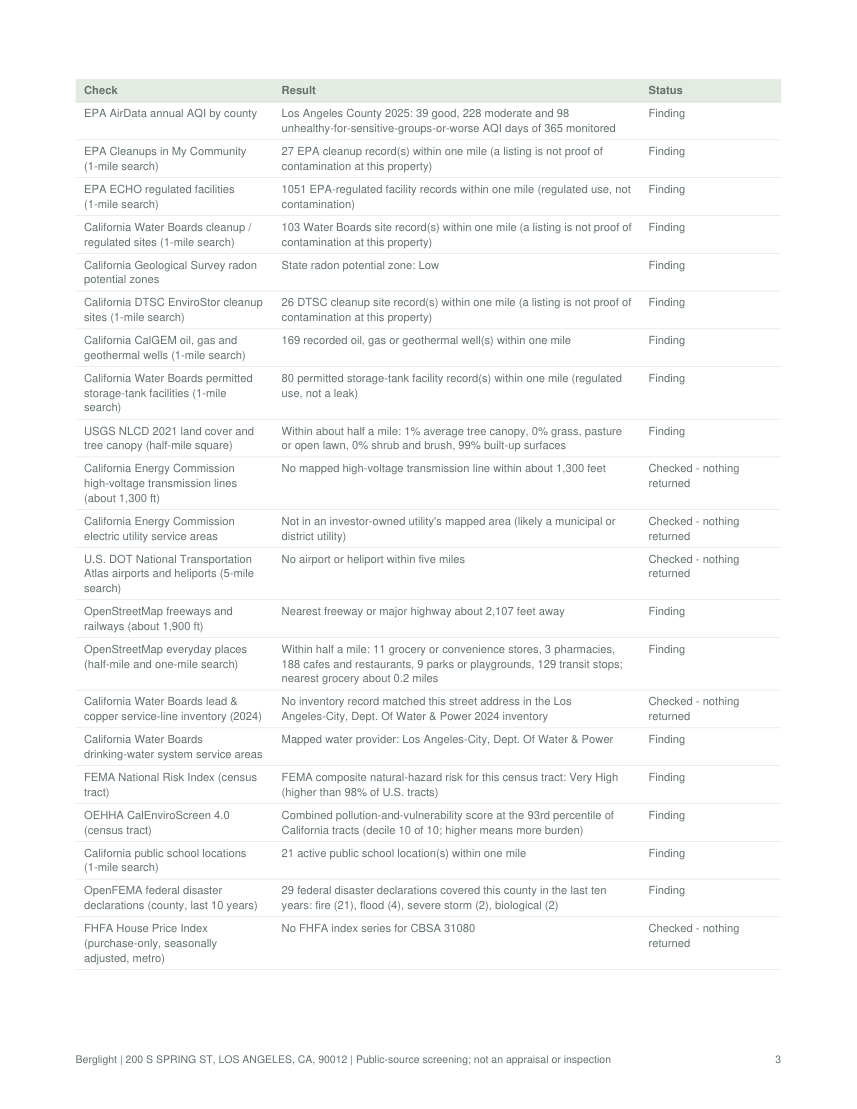
Real output for one California address, labeled as a sample. Not a customer report.
Whether the home sits in a mapped flood zone, with the effective map date, plus tsunami zones near the coast.
FEMA, California Geological SurveyThe state’s fire hazard severity class for the area, plus recorded past fires at the location.
CAL FIREFault, liquefaction and landslide zones, modeled shaking and slope, with unevaluated areas stated.
California Geological Survey, USGSWho supplies the water, and what the state’s service-line inventory says about the pipe.
California Water BoardsState and federal cleanup records, oil and gas wells and storage tanks within a mile.
EPA, DTSC, CalGEM, Water BoardsThe nearest high-voltage line, your electric utility, and airports within five miles.
California Energy Commission, U.S. DOTStores, pharmacies, parks and transit within half a mile, and the nearest freeway or railway.
OpenStreetMap contributorsEvery empty or unavailable record is listed, with the reason.
Always includedThese are illustrative examples built from the kinds of findings in our sample report. They are not customer stories, and your home’s records will differ.
Nothing here predicts what your report will say. A finding is a prompt to ask a better question, not a verdict.
Coverage firstEnter the address. We confirm the address and tell you which sources can cover it, before you pay anything. If we can’t cover it, we say so.
 One secure payment
Approve the scope and pay $15 through Stripe-hosted checkout. Berglight never receives your card number.
 A reviewed PDF
A person reads the report before we email a private download link. Delivery within 72 hours after payment.
Flood maps live with FEMA, fire zones with the state, water lines with the Water Boards, power lines with the Energy Commission. None of it appears in the photos. We read it for you and put it in one place.
Most of what we find is routine. The point isn’t to talk you out of a home you love. It’s to make sure the first time you hear about something is before you sign, not after.
Every item names its source, the date we retrieved it and the area we searched.
“We looked and found nothing” and “we couldn’t look” are never blurred together.
A person reads each report before delivery, and we correct material errors.
Checking an address is free. You pay $15 once, only if we can cover it and you approve the scope. No subscription and no account. Not an inspection, appraisal, title search, insurance quote or recommendation to buy.
Plain-language answers on flood, fire and ground hazards, comparisons with inspections and disclosures, free tools and guides for all 58 counties.
$15 per report, one time. Checking an address is free, and you only pay if we can cover it and you approve the scope. There is no subscription.
Any address in California. Some local layers, such as city zoning, are not part of the report, and it says so.
We decline the request before payment. If a source failure prevents the agreed report after payment, you can receive a refund.
Contact support with the finding and source. We investigate and correct material errors without a second report charge. See the refund policy for unresolved issues.
In California, sellers must provide a Natural Hazard Disclosure covering flood, dam, fire, fault and seismic zones. It’s a useful document, but buyers typically receive it during escrow, which is after an offer is accepted, and it covers hazard zones only. Berglight is for before you offer, and adds water-line records, nearby cleanup sites, power lines, freeways and airports, and a list of what couldn’t be checked. Ask your agent how disclosures work for your purchase.
They answer different questions. An inspector looks at the house itself. Berglight reads public records about the land, utilities and district, and gives you questions to ask. Many of them are for the inspector, your insurer or the city.
No. It organizes records and highlights follow-up questions. Missing records do not prove there are no hazards, liens, unpermitted work or defects.